


DVL Series Vacuum Lifters: Complete Glass & Stone Lifting Guide
DVL Series Vacuum Lifters: Installation & Operation Guide
A single operating mistake with a large glass or stone slab lifter can get expensive — cracked glass, chipped quartz, or worse, an injury on a curtain wall job site. Most of these incidents come from skipped procedures, not equipment failure.
DVL Series vacuum lifters from Ausavina — including DVL400, DVL480, DVL500, and DVL1000 — are built to minimize that risk. This guide covers setup, pre-operation checks, and step-by-step operation for curtain wall crews and factory personnel working with glass and stone slabs.
Mục lục
- 1. What Are DVL Series Vacuum Lifters?
- 2. Technical Specifications: Load Capacity Varies by Model
- 3. Pre-Operation Checklist
- 4. Adjusting Suction Cup Positions for Slab Size
- 5. Step-by-Step Operation Guide (Model DVL500)
- 6. Safety Features to Monitor
- 7. Why DVL Series Fits Curtain Wall and Factory Use?
- 8. Maintenance Tips
What Are DVL Series Vacuum Lifters?
DVL series vacuum lifters are a vacuum lifting system used to lift, rotate, tilt, and position large material slabs. A motor pulls negative pressure through rubber suction cups, holding the slab securely while it's moved. The unit rotates 360° and tilts 90°, and runs on a built-in battery, so it isn't tied to a fixed power cord.
The DVL series works as both glass handling equipment and stone slab lifting equipment, covering glass sheets, granite, marble, quartz, porcelain, and engineered stone.
Technical Specifications: Load Capacity Varies by Model
Each model in the DVL series is rated for a different load and suction cup count — higher capacity generally means more cups and a sturdier frame. Here's a reference point using the DVL500 vacuum lifter (4-cup, 220V with battery backup):
| Specification | Value (DVL500) |
| Rated load | 500 kg |
| Suction cups | 4, Ø300mm |
| Minimum slab size handled | 850 x 900 mm |
| Battery | 12V - 18Ah |
| Charging time | 6 hours 30 minutes |
| Time to reach -80 kPa | 30 seconds |
The DVL400 and DVL480 suit lighter, smaller panels where maneuverability matters most; the DVL1000 is built for larger, heavier stone slabs. The operation and safety procedures below apply across the whole series.
Pre-Operation Checklist
- Charge the battery fully before use — lifting pressure depends directly on available charge
- Inspect suction cups for damage or punctures; repair or replace as needed
- Check the air hose system for leaks or cracks
- Clean the material surface, free of dust and liquids
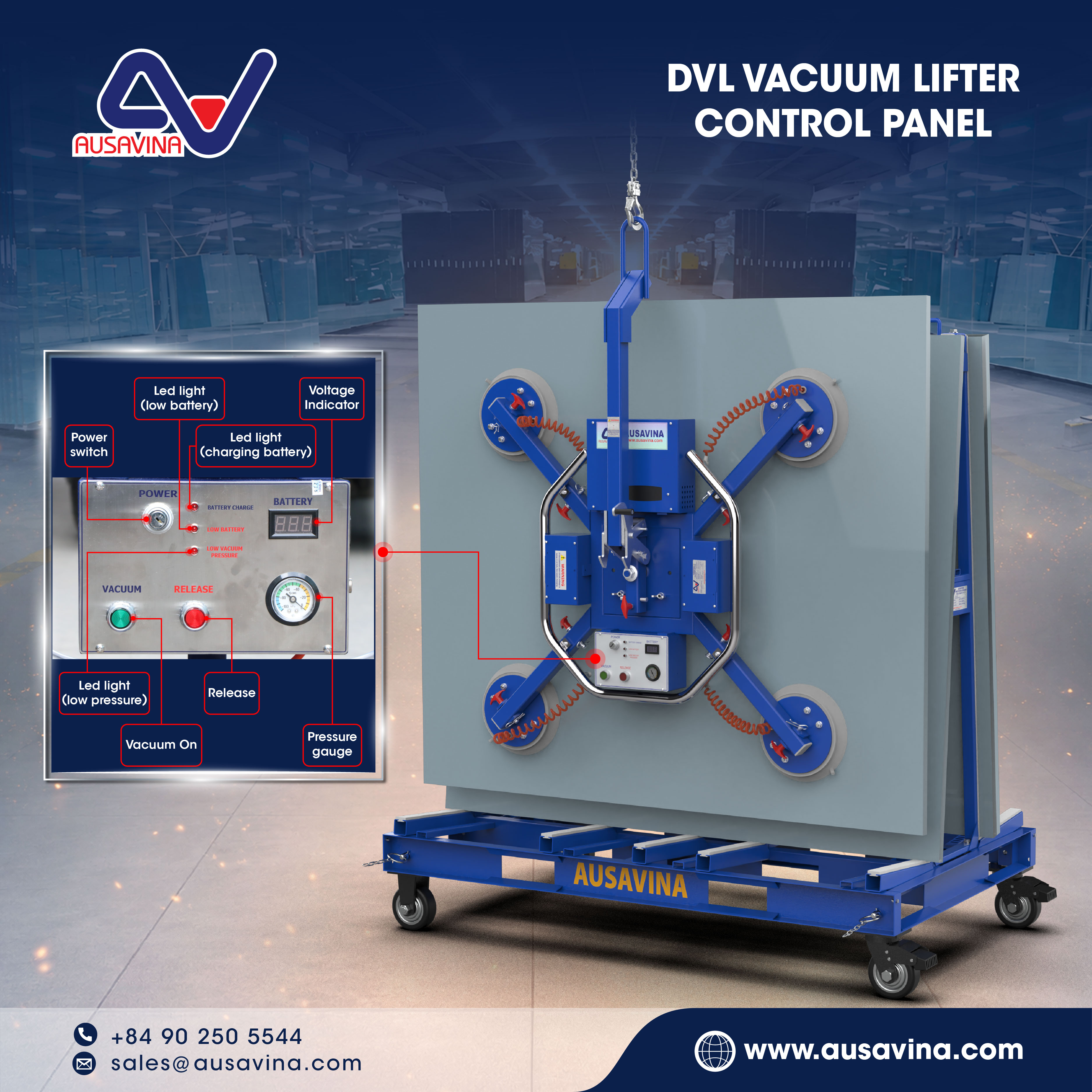
- Test control buttons, pressure gauge, and voltmeter; run a no-load test before attaching to actual material
Adjusting Suction Cup Positions for Slab Size
Cup positioning needs to match the slab's size and center of gravity. The DVL series supports four cup layouts (Positions A–D), covering minimum slab sizes from 400x1800mm up to 1300x1350mm. To reposition a cup, remove the retaining clip and pin, slide the arm into place, then reinstall.

The suction frame also rotates between vertical mode (curtain wall installation) and horizontal mode (slabs on a fabrication table) — pull the locking lever and rotate to the required angle.
Step-by-Step Operation Guide (Model DVL500)
Operating vertical glass panels (curtain wall):
- Attach the crane hook and position the unit centered on the panel
- Bring the unit flush against the glass, ensuring all cups contact simultaneously
- Press VACUUM (green) and confirm the gauge reaches -70 to -80 kPa
- Lift, move, and rotate the panel 45°/90° as needed
- Place the panel gently — never engage the 90° tilt while under suction
- Hold RELEASE for 5 seconds, wait for the gauge to hit 0, then remove the unit
Operating horizontal slabs (stone, quartz, porcelain): same process, after switching the suction frame to horizontal mode.
Key rule throughout: never press RELEASE while the unit is holding a load, and keep the gauge within -70 to -80 kPa during the entire lift.
Safety Features to Monitor
Vacuum lifter safety features that help catch problems early:
- Three-zone pressure gauge — yellow (danger), green (caution), blue (safe)
- Low pressure / low battery alarms — LED and audible alert when pressure drops to -60~0 kPa or battery falls below 12V
- Keyed power lock switch to prevent unauthorized operation
- Remote pendant control with ON, OFF, VACUUM, and RELEASE buttons
Why DVL Series Fits Curtain Wall and Factory Use?
With 360° rotation, 90° tilt, and battery power, the lifter helps curtain wall crews install glass at height without trailing power cords. For factory operations handling stone, quartz, and porcelain, switching quickly between vertical and horizontal modes means one unit covers multiple production stages.
Maintenance Tips
- Schedule regular checks on suction cups and electrical components, tighten bolts periodically
- Keep the unit clean — avoid grease or oil contact with rubber cups
- Store in a dry space; maintain battery at 12.4~12.6V
| Common Issue | Fix |
| Suction cup won't seal | Clean or replace the cup |
| Pressure won't reach -60~-80 kPa | Check for hose/valve leaks, repair or replace |
| Slab rotates with difficulty | Apply oil or grease to the joint |
Conclusion
DVL series vacuum lifters deliver a safe, flexible lifting solution for curtain wall installation and factory slab handling — but the real value shows up only when operators follow the checklist, watch the warning signals, and stick to regular maintenance.
Need help choosing the right model — DVL400, DVL480, DVL500, or DVL1000 — for your project? Reach out to Ausavina's technical team for detailed specs and full operating guidance.
Related Posts

.[1].jpg)



 944/1, Nguyen Thi Minh Khai Street, Tan Thang Quarter, Tan Dong Hiep Ward, Ho Chi Minh City,Viet Nam.


